Investments in electricity and energy efficiency
Module 4Lection 2
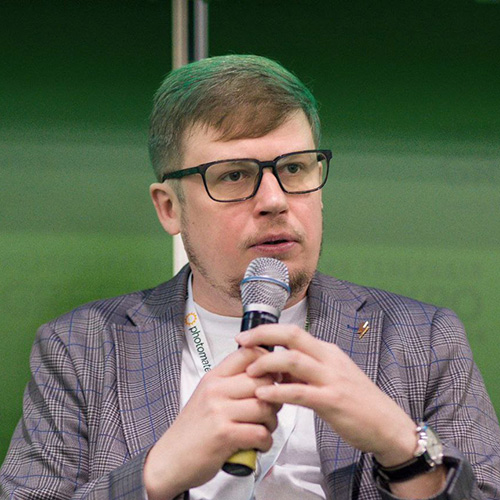
Stanislav Ignatiev – Doctor of Technical Sciences, Professor, Chairman of the Council Chairman of the Council of the Ukrainian Renewable Energy Association, founder of the Kharkiv Energy Cluster.
For five years, he was the Executive Director (CEO) of Solar Generation LLC, performed the function of a crisis manager, reformatting the business, achieving a net profit of UAH 335 million per year.
He has experience in managing construction projects of 110 MW of solar power plants and 25 MW of wind power plants from the “green field” development stage, obtaining permits to commissioning and subsequent operation management.
Optimized business management processes through automation of dispatch control and generation forecasting.
Developed and prepared to the “ready to build” stage investment projects in “green” energy: 180 MW of solar power plants, 45 MW of gas-piston power plants, 52 MW of wind.
In the Office of the President of Ukraine in 2021-2022, he led the development group of the President’s Program “Great Thermal Modernization”: from team formation, creation of a KPI system, organization of “brainstorming” and “strategic sessions” to the presentation of the Program at the level of the First Vice Prime Minister of Ukraine, a relevant deputy of the Office of the President, and the President of Ukraine.
Chairman of the Council of the Ukrainian Association of Renewable Energy, which unites 82 electricity generating companies. Public lobbying for regulatory legal acts that ensure transparency and efficiency of the electricity market. Systematic public speeches at the largest industry forums and conferences in Ukraine and Europe.
Founder of the Kharkiv Energy Cluster, the largest association of 38 small and medium-sized businesses in Ukraine (energy, construction, law and financial management).
In addition, Stanislav Ignatiev was the head of non-extractive projects in the Kharkiv region of Shell Ukraine LLC, and as the director of WSB Ukraine LLC, he established the international energy holding WSB Green Energy in Ukraine. As the head of the Ukrenergo Laboratories project of PJSC NPC Ukrenergo, he made a lot of efforts to create a positive image of the company, form a personnel reserve, and collect innovative ideas for the development of the national electricity transmission system operator.
Honorary Professor of the European Institute of Second Education (Slovakia), MBA in Sustainable Energy, London School of Economics, Ph.D. in Energy, Dresden University of Technology (Germany). Speaks English, Polish, and German.
Lecture content
- State of Ukraine’s energy system as of February 24, 2022
- State of Ukraine’s energy system in 2025
- Impact of war on renewable energy
- Threats and challenges for the Ukrainian energy sector
- Investment potential: what is needed for Ukraine’s energy sufficiency
- Success stories: renewable energy for communities and business
- Active links (NPAs, standards, resources)
- Glossary
- Questions for self-test
1. State of Ukraine’s energy system as of February 24, 2022
Let’s start with what our energy system was like before the full-scale invasion.
The Unified Energy System of Ukraine at that time looked like this:
- The hourly weighted average electricity consumption was 17.67 GWh;
- The annual total consumption was 154,830 GWh.
If we look at the structure of energy resources use, the picture was as follows:
- 22.6% — nuclear energy,
- 23.9% — natural gas,
- 10.7% — petroleum products,
- 11.4% — hydropower,
- 5.9% — renewable energy sources.
By the structure of electricity generation, we have the following ratio:
- 56.1% was provided by nuclear power plants,
- 29.3% — thermal power plants (TPP and CHP),
- 8.7% — hydroelectric power plants and pumped storage,
- 5.9% — renewable energy sources.
The total installed power generation capacity of Ukraine was 55,579.2 MW, including:
- NPP — 13,880 MW (15 power units),
- TPP and CHP — 30,545 MW (112 power units),
- HPP and PSP — 6,646.7 MW (14 hydroelectric facilities),
- RES — 4,507.5 MW (by output).
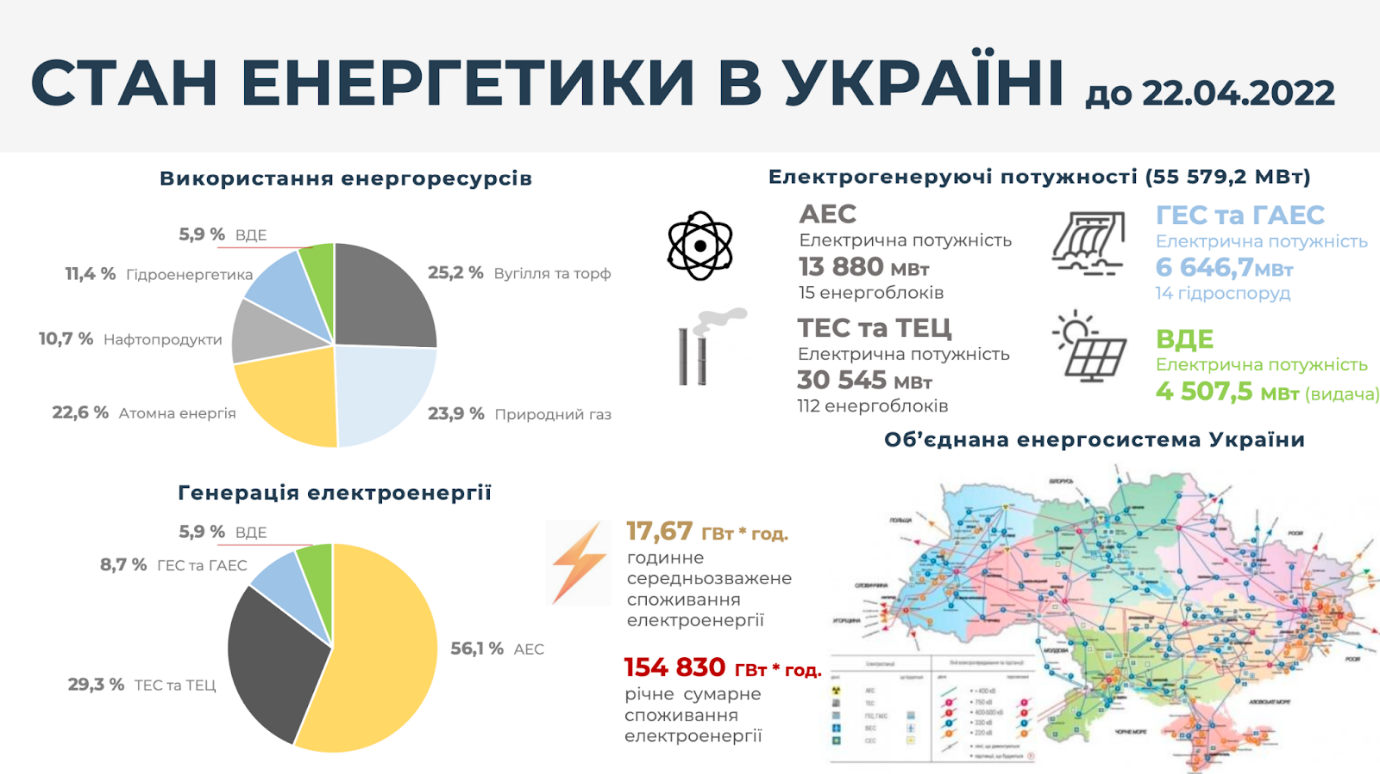
The basis of our energy system has traditionally been nuclear generation. And although thermal plants had almost three times the installed capacity, their actual output was much less. However, it was thermal plants that performed a very important function — they balanced the system in the morning and evening hours, when peak demand arose. Until the end of April 2022, we still produced and consumed enough electricity to cover our own needs.
But then everything changed. The super-powerful Zaporizhzhia nuclear power plant was occupied — the largest in Europe and one of the largest in the world. The level of nuclear generation fell sharply, and since then the country has been unable to fully meet its electricity needs.
At first, attempts were made to balance the situation with hydropower. However, constant shelling and destruction of facilities, as well as drought in the summer, did not allow the reservoirs to be fully filled. This became a big problem, because even hydroelectric power plants could not fulfill their balancing role.
Thermal generation also suffered catastrophic losses – most of the facilities were damaged or destroyed. At that time, solar power plants were still operating in Ukraine, but they also gradually began to stop – due to the fact that there was not enough capacity for balancing.
As of April 22, 2022, the average deficit in the energy system was about 2.7 GWh per day. Because of this, large enterprises were forced to stop. And even then they began to actively build their own generating capacities.
In fact, today energy in Ukraine has ceased to be just a technical issue. It has become a political and socio-economic issue. Why? Because the energy deficit is now being translated into business. Enterprises are installing generators, gas-piston installations, energy storage systems. It all works, but the cost of such electricity is much higher than the tariff for the end consumer.
And it turns out that the population pays for the official tariffs. This creates social tension. So our energy system is now not only about technology and capacity, but also an area where the interests of the economy, politics, and society intersect.
2. State of Ukraine’s energy system in 2025
Now let’s see what state our energy system is in today, in 2025.
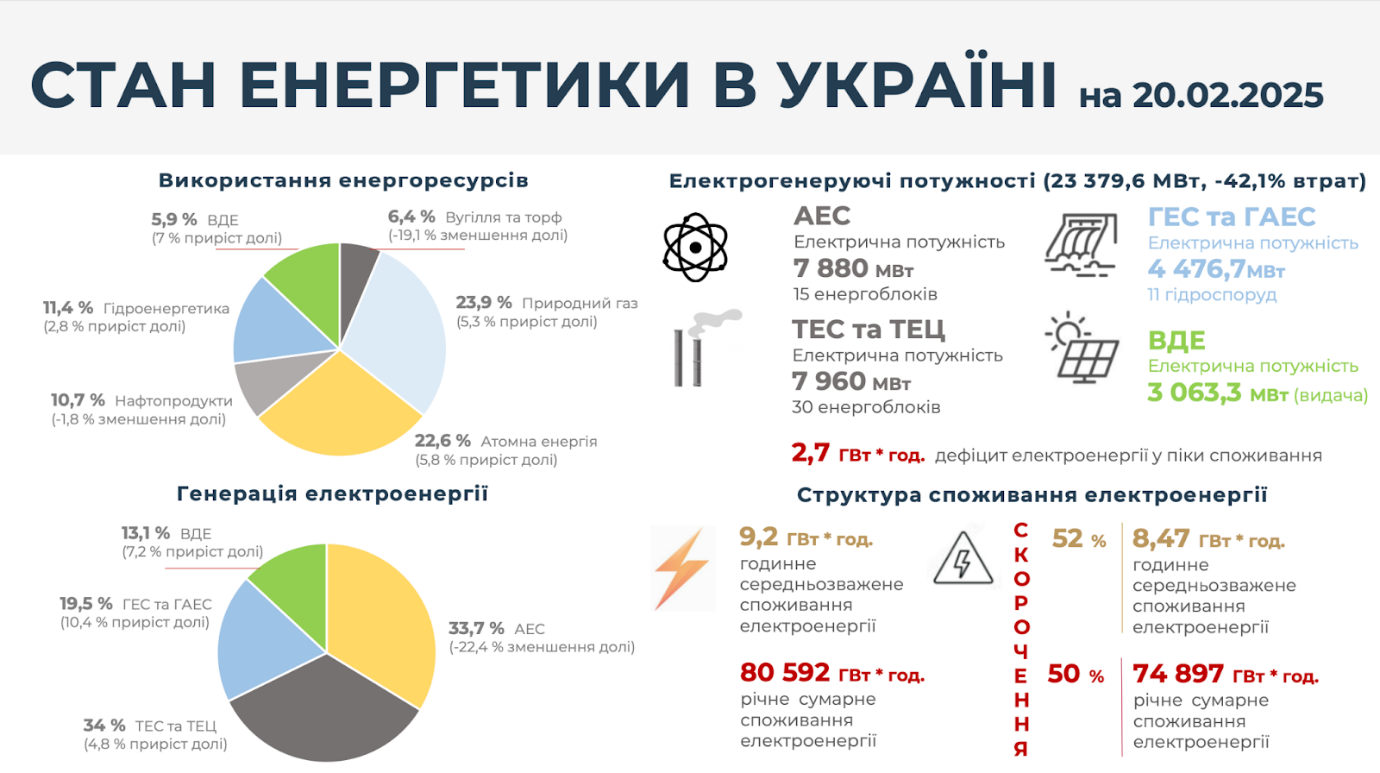
Total installed capacity has been reduced by almost half — minus 42.1% from pre-war levels. Currently, we have 23,379.6 MW in operation:
- nuclear generation — 7,880 MW (15 power units),
- thermal generation (thermal power plants and combined heat and power plants) — 7,960 MW (30 power units),
- hydroelectric power plants and pumped storage — 4,476.7 MW (11 hydropower plants),
- renewable energy sources — 3,063.3 MW (fordacha).
The consumption structure has changed very significantly.
- The hourly average consumption has more than halved — from 17.67 to 8.47 GWh.
- Annual consumption has fallen from over 154 thousand to 74,897 GWh.
- The deficit during peak hours remains stable — about 2.7 GWh.
Now about the fuel structure. Our share of natural gas use has increased — 23.9%, which is 5.3% more. Nuclear energy occupies 22.6%, also plus 5.8% in the structure. Hydropower has grown to 11.4%. The share of renewables has risen to 5.9%. At the same time, we see a decline in oil products and especially coal and peat, their share has fallen by almost 20%.
If we look at electricity generation, the picture looks like this:
- 34% is produced by thermal power plants and CHP (the share has increased),
- 33.7% — nuclear power plants (the share has significantly decreased compared to the pre-war level),
- 19.5% — hydroelectric power plants and PSPP (it has increased by more than 10%),
- 13.1% — renewables (this is also an increase).
Now a few words about gas. In 2023, it became clear that we can still provide the housing and communal services sector with gas from our own production. But today, more than half of this production has been destroyed. The situation is difficult, and yet the country has relatively stably passed the 2024–2025 heating season. We have done without expensive Russian gas, purchasing European gas.

3. The impact of the war on renewable energy
The scale of losses in the energy system can be called catastrophic. And here it is worth remembering that we entered the “green transformation” from a fairly high starting position.
- In 2019, Ukraine entered the TOP 10 countries in the world in terms of the pace of development of renewable energy.
- In 2020, it entered the TOP 5 countries in Europe in terms of the pace of development of solar energy.
- At the beginning of 2022, we already had 9,656 MW of green generation capacity.
But the war hit this sector the hardest:
43% of our “green” capacity ended up in the temporarily occupied territories of Ukraine — about 3,980 MW.
The total capacity of industrial solar power plants was 6,226.9 MW. But about 60% of them are located in the southern and southeastern regions, precisely where there is active fighting. We have lost 30 to 40% of such solar power plants, that is, from 1,120 to 1,500 MW.
As for wind energy.
We had 1,673 MW of wind power plants.
Today, more than 2/3 of these capacities are stopped. 1,162.5 MW is not working, and only 372.5 MW remain in operation. The main wind turbines are currently concentrated in the Odessa and Lviv regions.
Bioenergy.
The total capacity of biomass and biogas facilities is 224.5 MW (of which 119.1 MW is biomass and 105.4 MW is biogas).
About 15% of this capacity has been damaged.
And finally, the situation with networks.
For every 100 km of power lines, we have an average of 50 damages.
Work is underway to restore 11 high-voltage lines and 17 substations.
Up to 600 km of 110 and 150 kV networks, over 1,000 km of 35 kV networks, as well as more than 20 substations of 110 and 35 kV classes have been damaged.
These are colossal losses for a country that, just a few years ago, was demonstrating record rates of development of renewable energy. But at the same time, we also see potential: even in these conditions, green energy remains one of the most sustainable areas of development.
4. Threats and challenges for the Ukrainian energy sector
Today, we are facing a number of systemic problems that are radically changing the country’s energy supply model.
First. Irreversible destruction of classical generation. Huge thermal power plants, entire coal clusters have been destroyed. This means that the base and maneuvering capacities that we have relied on for decades have actually been lost. And that is why we see the growth of “green” generation based on the principle: we generate where we consume. This is a distributed model that is becoming increasingly important.
Second. Destruction of the transmission and distribution system. NPC “Ukrenergo”, regional energy companies – hundreds of lines, dozens of substations are damaged. And what is happening? We are forced to switch to a model that has been working in the USA for a long time: each administrative unit actually creates its own generation system and provides itself with energy separately. This is decentralization not “from above”, but forced, due to the war.
Third. Coal and hydropower. The coal industry is destroyed. Classic coal-fired power plants have been destroyed, many of them cannot be restored. Hydropower has also suffered serious damage: the loss of large hydropower capacities means that we no longer have a tool for flexible balancing of the power system.
And fourth. The transition to gas-piston plants. What do we see instead? During peak hours, the deficit is covered thanks to shunting gas-piston plants. This is, in essence, a new balancing model that is gradually being integrated into the system.
Thus, the war has radically changed the architecture of the power system: we are moving from a centralized model to a decentralized one, from large plants to distributed resources, from classic capacities to more flexible and maneuverable solutions.
5. Investment potential: what is needed for Ukraine’s energy sufficiency
In order to simply restore Ukraine’s unified energy system after the destruction, we need about 43 billion US dollars. This is almost twice as much as the country’s entire annual budget before the full-scale invasion — about 22 billion dollars. So the scale of the problem and the challenges are obvious.
And now another question: how much money is needed not only for restoration, but also for the complete transformation of the energy system, for the creation of a modern, sustainable, “green” architecture that meets EU standards?
The calculations are as follows:
- Hydropower — over 58 billion dollars;
- Solar power — almost 24 billion;
- Wind power — about 15 billion;
- Gas-piston generation — 5.4 billion;
- Electricity networks — the largest item, over 89 billion.
In total — 192 billion US dollars. This figure shows the scale of the task: restoration is not enough, transformation is needed.
Now let’s focus on the near future.
We are talking about gas-fired power plants. The need for them is huge – over 2.7 gigawatts for the social sphere alone. This is approximately 905 machines that could be delivered to Ukraine in three years. But in reality, only two or three hundred can be connected.
What do we have? For the entire year of 2024, only 93 units with a total capacity of 91 MW were installed. This is not even 10% of the plan announced by the President. Half of these machines were purchased at the expense of international technical assistance, but have not yet been installed – because the installation must be financed from local budgets, and there are problems with this.
And at the same time, business is not standing aside. In 2024, it was the private sector that provided almost 1 gigawatt of new distributed generation capacity. This is a signal: despite all the difficulties, the economy finds a solution.
6. Success stories: RES for communities and business
Case 1. “Ready to build” – from site to station
Initial data: BioCHP 5.8 MW and SPP 11.24 MW at the start of preparation.
Solution: to make the project attractive to investors, the community carried out all preparatory procedures:
- added plots to the boundaries of the settlement;
- united land plots for the solar power plant;
- changed the purpose;
- received cadastral numbers;
- approved a detailed plan of the territory and urban planning conditions;
- held public hearings;
- received technical conditions for connection.
Result: the investor received a ready-made site for the construction of the station without bureaucratic barriers.
Case 2. Communal solar power plant
Input data: the community planned its own solar power plant.
Solution: The project was implemented in two stages:
- Stage 1 – 0.4 MW with international aid funds;
- Stage 2 – 0.8 MW as a private investment.
Model: creation of a KP, investor’s entry into corporate rights, formation of a Community Development Fund. Profit is directed as a non-repayable grant.
Result: The community received its own generation, the investor is a stable project, and electricity can be sold to the community at a feed-in tariff.
Case 3. Kindergarten – power plant
Input data: The kindergarten consumes about 30 kW + a heat pump for 35 kW.
Solution: A 120 kW solar power plant was installed on the roof.
Stages:
- creation of a KP – the owner of the station;
- tender through Prozorro for the rental of the roof;
- approval of the project in the education department;
- reconstruction of the roof and removal of inverters.
Result: the institution receives its own “clean” energy supply and can even sell the surplus to the network.
Case 4. Energy-independent community – Vesele village
Input data: the community spent significant amounts of money on energy sources.
Solution: a set of measures has been implemented:
- Solar power plant – 1.2 MW;
- Solid fuel boiler houses – 2.6 MW (straw and sunflower husk);
- Heat pump;
- 38 solar collectors;
- SMART street lighting system.
Savings results:
- School – 82% (equivalent to 3.3 million UAH).
- Club and library – 75% (equivalent to 900 thousand UAH).
- Outpatient clinic – 90% (equivalent to 415 thousand UAH).
- Street lighting – 87% (equivalent to 315 thousand UAH).
Conclusion: the community covers 100% of its energy needs through renewable energy sources and demonstrates a practical model of an energy-efficient village.
Active links
- Law “On the Electricity Market” (Vedomosti Verkhovna Rada (VVR), 2017, No. 27-28, Art. 312): https://zakon.rada.gov.ua/laws/show/2019-19#Text
- Law “On Alternative Energy Sources” (Vedomosti Verkhovna Rada of Ukraine (VVR), 2003, No. 24, Art. 155): https://zakon.rada.gov.ua/laws/show/555-15#Text
- Law of Ukraine “On Energy Efficiency” (Vedomosti Verkhovna Rada of Ukraine (VVR), 2022, No. 2, p. 8): https://zakon.rada.gov.ua/laws/show/1818-20#Text
- Text of the Paris Agreement (PDF) — official publication of the UNFCCC: https://unfccc.int/sites/default/files/resource/parisagreement_publication.pdf?utm_source=chatgpt.com
- European Green Deal: https://commission.europa.eu/strategy-and-policy/priorities-2019-2024/european-green-deal_en
- Ukraine FacilityThe EU’s financial support program for Ukraine: https://www.ukrainefacility.me.gov.ua/
- Ukrainian Wind Energy Association (UVEA): https://uwea.com.ua/ua/
- Ukrenergo NPC Generation Capacity Adequacy Report: https://ua.energy/zvit-z-otsinky-vidpovidnosti-dostatnosti-generuyuchyh-potuzhnostej/